
Custom Jewelry Manufacturing: Materials, Plating and Packaging
A custom program is decided in three layers: the metal, the finish and the pack. Each carries its own minimum, and the three interact more than most briefs allow. TTT Jewelry publishes 50 pieces for 925 sterling silver, 100 for artisan eco-brass and 100+ for stainless steel, with a 48–60 day path from CAD to delivery.

Key takeaways
- Silver starts at 50 pieces per design, brass at 100 and stainless at 100+, so metal choice sets the floor.
- Plating options run through 14K, 18K and 24K gold, rhodium, e-coating and PVD, all inside REACH and CA Prop 65.
- Packaging is five listed items, and each one needs artwork approval before production.
- CAD under 48 hours plus 25–30 days of sampling plus 3–4 weeks of production gives 48–60 days.
The order in which the three layers lock
Material comes first because it sets both the minimum and the process route. Plating follows, because the finish has to suit the metal: electrolytic gold and rhodium on silver and brass, PVD vacuum plating on stainless, anti-tarnish e-coating on silver and brass. Packaging comes last in the conversation but not in the schedule, because a private-label order usually needs a logo tag, a box and a barcode before it can ship.
A custom jewelry manufacturer running all three metals has to hold three process routes rather than one. That is the practical reason a brief should name the metal before it names the colour, and the reason a quotation that covers one metal rarely transfers cleanly to another.
The three layers also fail in different ways. A metal error shows up as a wear complaint, a plating error shows up as a colour change, and a packaging error shows up on the shelf before the customer ever opens the box.
Material sets the floor
925 sterling silver starts at 50 pieces per design. Artisan eco-brass starts at 100. Stainless steel starts at 100+. The figures apply per design rather than per order, so a five-design silver collection commits 250 pieces and a five-design brass collection commits 500.
Beyond quantity, the metals differ in what they need. Silver and brass take anti-tarnish e-coating; stainless takes PVD and relies on the alloy and the film rather than an organic barrier. 316L carries 2–3% molybdenum and is published as waterproof, shower-safe and swim-proof; 304 is water-resistant for daily wear and suits cost-effective volume. The metal choice is therefore also a care-instruction choice, and the care card should match the alloy.
Buyers who want the full stainless route can read the stainless steel jewelry manufacturer page, which separates the two grades and states the minimum in one place.
Plating and the compliance floor
The published finish menu is multi-layer 14K, 18K and 24K gold, rhodium, anti-tarnish e-coating and PVD. Each is a process step with its own preparation and inspection, and plating is stated as 100% compliant with REACH and CA Prop 65.
Compliance belongs to the finish decision rather than to a separate audit. REACH restricts lead, cadmium and nickel; Prop 65 governs the United States disclosure; ISO 9001:2015 is the quality system that keeps the plating record traceable from bath to batch. A buyer moving from gold-plated brass to PVD stainless changes the chemistry, the process and the compliance file at the same time.
That is why the metal and the finish should be signed off together. Approving a colour on a brass sample and then switching the body to stainless produces a different coating system, even when the two look alike in a photograph.
Packaging is a list, not a detail
The published packaging options are metallic logo tags, foil-stamped gift boxes, velvet or microfiber pouches, display backing cards and barcode labelling. Five items, each with its own artwork and its own approval.
The approval sequence matters. A logo tag and a backing card carry the brand mark, so they need sign-off before the production run, not after. Barcode labelling links the piece to a SKU, which means the packaging plan has to match the assortment plan. A buyer who orders packaging after the jewelry is packed is ordering a repack.
For buyers who want the concept developed rather than built to a supplied drawing, the OEM/ODM model covers design through delivery; the OEM route builds to the buyer's CAD and leaves the intellectual property with the buyer. Either way, the packaging list is the same list, and the artwork clock starts when the collection is confirmed.
The table sets the published options against the minimum and the schedule, so the interaction between the layers is visible on one page.
| Layer | Published options | Effect on quantity | Effect on calendar |
|---|---|---|---|
| Metal | 925 silver, eco-brass, stainless | 50 / 100 / 100+ per design | Sets the process route |
| Plating | 14K, 18K, 24K gold, rhodium, e-coat, PVD | No separate minimum | Adds process steps |
| Stones | Natural stones, freshwater pearls | Counted per design | Setting time in sampling |
| Logo and hallmark | Laser engraving, S925 / 316L / 18KGP | No separate minimum | Artwork approval |
| Packaging | Tags, boxes, pouches, cards, barcodes | Tied to order volume | Proofing before packing |
Read the first column down and the dependency is obvious: every later layer inherits the route chosen at the top. Read the third column down and the minimum never moves for plating, stones or marks, because those are per-piece decisions inside a design, not separate orders.
Worked example
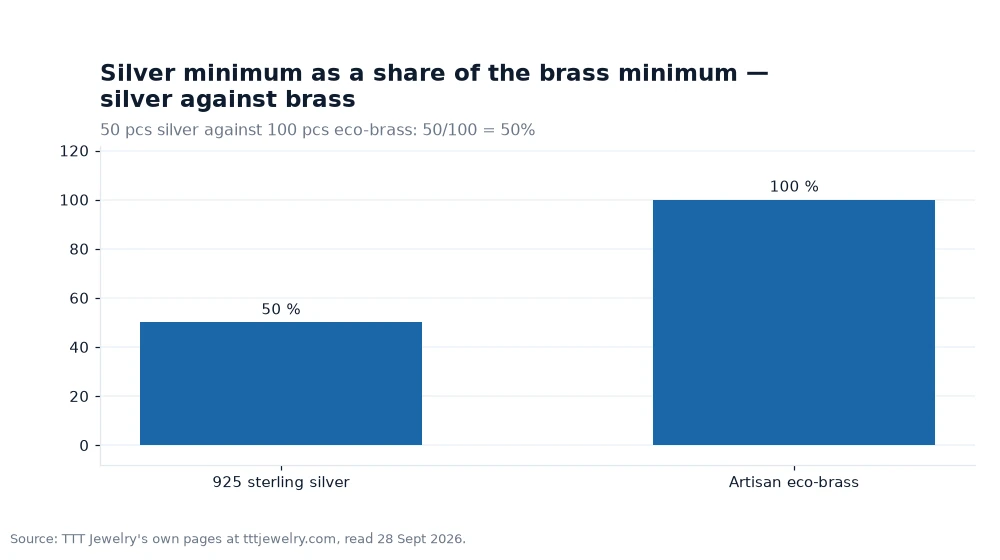
Silver at 50 pieces is 50/100 = 50% of the brass minimum. Put that against a three-design launch: 3 × 50 = 150 silver pieces, or 3 × 100 = 300 brass pieces, for the same three designs. The silver programme carries half the units and a higher metal value per unit, which is why the two are rarely compared on unit price alone.
Time behaves differently. CAD is under 48 hours, sampling is 25–30 days and production is 21–28 days, so the total is 2 + 25 + 21 = 48 days at the fast end and 2 + 30 + 28 = 60 days at the slow end. Packaging proofing sits beside that path rather than inside it, which is the argument for starting artwork at the same time as CAD.
The CAD share is 48/600 = 8% of a 25-day sampling window and 48/720 = 6.7% of a 30-day window. Two days of design work against a month of bench time is the ratio that makes a complete brief worth the effort.
Frequently asked questions
What is the minimum order for custom silver jewelry?
925 sterling silver starts at 50 pieces per design, which is half the 100-piece artisan eco-brass minimum.
Can one order mix silver, brass and stainless?
The three metals run on separate process routes with different minimums, so a mixed order is planned as three lines rather than one.
How long does a custom jewelry program take?
CAD takes under 48 hours, sampling 25–30 days and production 21–28 days, giving a 48–60 day total for a first order.
Deciding the three layers in one meeting
Bring the metal, the finish and the pack into the same decision, and the brief stops moving after approval. The metal sets the minimum, the finish sets the compliance file, and the pack sets the ship date. For repeat orders where the tooling already exists, the custom jewelry wholesale structure carries the same three layers forward without redeveloping them.
Source note: figures come from the manufacturer's own website (tttjewelry.com), read 28 Sept 2026.[1]