
Sample Drift on a First Order: Approving Against a Retained Reference
Drift between an approved sample and the bulk run is normal, and most of it is explainable before it happens. The failure is not that the two differ; it is that nobody wrote down what would count as acceptable, so every later comparison becomes an argument about memory. A first order can be structured so that the approved sample stays a reference rather than a souvenir.
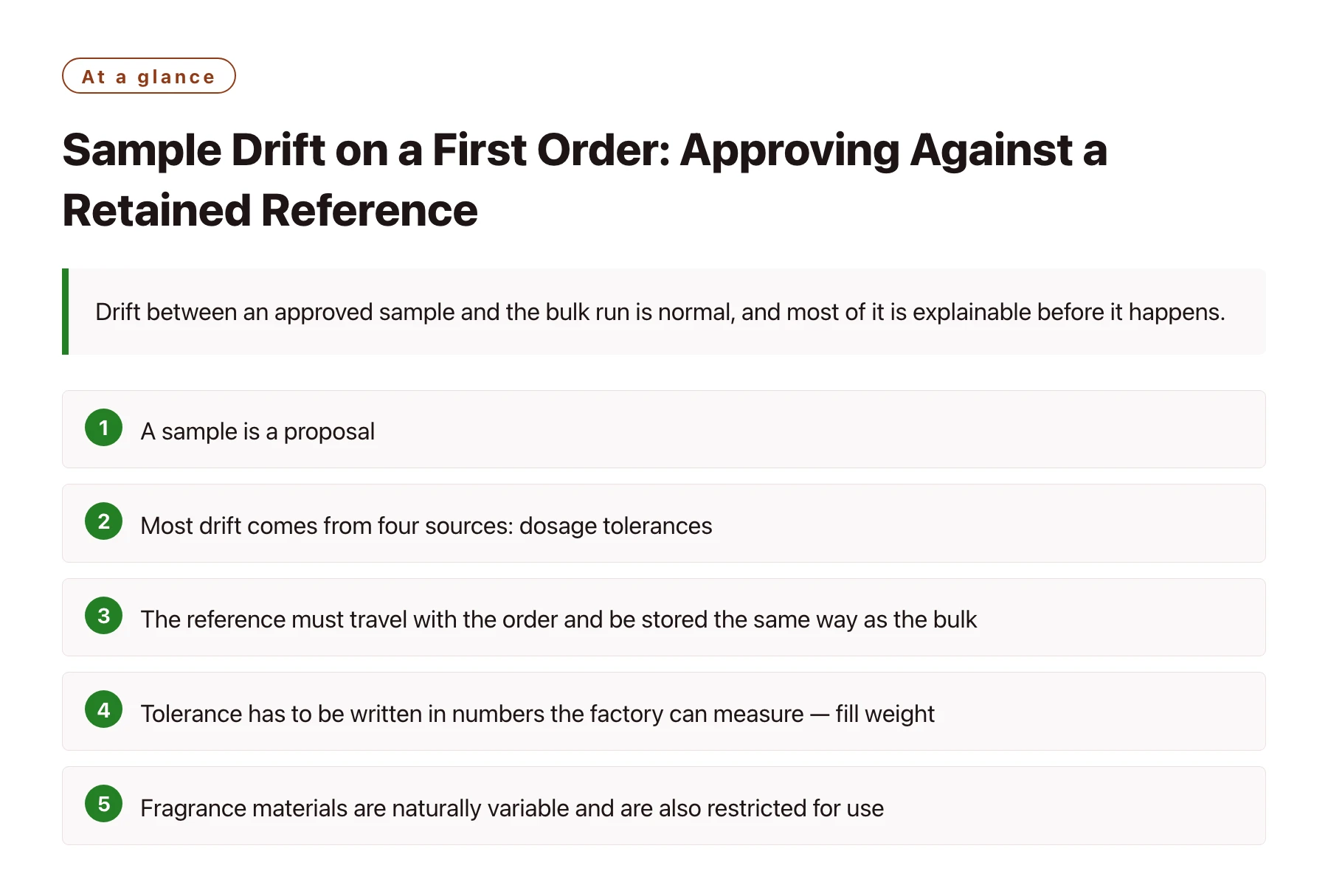
Key takeaways
- A sample is a proposal, not a specification, until it is sealed, labelled and held by both sides as the reference for the order.
- Most drift comes from four sources: dosage tolerances, material batch variation, filling or storage conditions, and time spent resting between approval and production.
- The reference must travel with the order and be stored the same way as the bulk, because a sample kept on a sunny shelf is not a fair comparison point.
- Tolerance has to be written in numbers the factory can measure — fill weight, dosage, colour, spray output — rather than in adjectives like close or similar.
- Fragrance materials are naturally variable and are also restricted for use, so both the safety framework and the raw material chemistry set limits on how exactly any formula can be reproduced [1].
- A defined re-check point, agreed before production, converts a disagreement into a routine comparison against the retained reference.
The first bulk order is the moment a scent stops being a concept and becomes inventory. It is also the moment when the sample that everyone approved starts behaving like a different product, and the reason is rarely negligence. Small differences accumulate along a chain of ordinary steps, and each step on its own is invisible.
This walkthrough is written for the person who owns sample approval on a first order: what to fix at approval, what to ask for before production, and what to do when the first cartons arrive and the scent is not quite the sample.
Why the approved sample and the bulk run are not the same object
An approval sample is usually made in small quantities, sometimes by hand or on laboratory equipment, and it is often evaluated within days of being blended. A bulk run is made in a different vessel, from materials with their own batch histories, filled on a production line and then stored in cartons. The gap between the two is not a defect; it is the difference between a laboratory and a factory.
The question worth answering is directional: is the bulk version inside the same olfactive neighbourhood as the approved reference, and does it stay there over the product's life? That question can be answered with a retained reference and a written tolerance, and it cannot be answered with a vague memory of what the sample smelled like in a meeting room.
It helps to separate the reasons that belong to the material itself from the reasons that belong to the process, because only the second group is under a buyer's direct control. A published explanation of why a sample and the bulk order can differ covers the material and dosage side; the discipline described below is what the brand side can specify, ask for and check.
A first-order walkthrough, from approval to bulk arrival
- Fix the reference at approval, not laterWhen you approve, ask for the approved version to be sealed, dated, labelled with the formula version and the dosage, and split so that both sides hold a physical unit. The approval email should name that specific unit, not the round of sampling in general.
- Write the tolerance while the conversation is friendlyState what will be measured: fill weight and its range, fragrance dosage, liquid colour, clarity, spray output where relevant, and the number of units that may fall outside. A tolerance agreed before production is a specification; one agreed afterwards is a negotiation.
- Ask how the bulk will be tested against the referenceWho performs the comparison, on what substrate, at what point in the run, and what happens if the result is borderline. The answer should be a process, not a promise.
- Confirm storage and shipping conditionsHeat and light move a fragrance faster than time does. Confirm the storage temperature range, the transit conditions and whether the retained reference is stored under the same regime as production stock.
- Re-check on arrival and record itCompare the delivered goods against the retained reference on the same day, in the same conditions, with the same people where possible. Log the result. A written record is what allows a pattern to be seen across future orders.
Four sources of drift and the lever that contains each one
| Source of drift | What changes | Practical lever |
|---|---|---|
| Dosage tolerance | The fragrance percentage sits at the edge of the permitted range rather than at the approved value | Specify dosage with a narrow range and require it on the batch record |
| Material batch variation | Natural and nature-identical materials differ slightly between lots, and substitutions happen when a material is tight | Require notification and approval for any substitution, even a compliant one |
| Process and filling | Mixing time, order of addition, temperature, fill speed and line conditions shift the result | Agree the critical process parameters and ask which of them are recorded per batch |
| Time and storage | A sample judged fresh and a bulk unit judged after transit are at different points in their lives | Compare like with like, and keep the retained reference under the same conditions as stock |
None of these levers removes drift. Together they make it measurable, which is the only thing that lets you decide whether a batch is acceptable rather than merely different [2].
What to do when the first cartons arrive and the scent is not the sample
Start by re-reading the reference conditions before judging the goods. A bulk unit that has travelled through a warm warehouse and a sample kept in an air-conditioned office are not comparable, and a meaningful share of first-order complaints dissolve at this step. If the difference survives a fair comparison, document it in language both sides can act on: which direction, how far, at which point in the wear, and on which substrate.
Then decide whether it is a tolerance question or a formula question. If the batch record shows dosage inside the agreed range and the difference is a matter of degree, you are looking at process variation and the fix is tighter parameters on the next run. If a material was substituted or the dosage moved outside the range, the conversation is about rework, credit or replacement, and it is much easier to have because the numbers were agreed in advance.
It also helps to understand how much of the production chain sits with one party. A partner offering one-stop fragrance manufacturing is usually better placed to trace which step moved, because the compounding, filling and packing records are in the same building rather than split across suppliers.
Finally, remember that the sample you approved was also a moment in time. Most fragrances continue to change slowly after blending, so a bulk batch that smells slightly rounder than a freshly made sample may be closer to what the product will smell like for most of its life. The retained reference is there to hold the target steady, not to freeze a fragrance at the age of ten days.
Turn the first order into a baseline
The most valuable output of a first bulk order is not the stock. It is a set of measurements and a retained unit that make the second order easier to judge. Brands that keep the first batch record and its reference alongside the approved sample are able to answer the question of what changed months later, when the scent is on a shelf rather than in a meeting.
If the answer to why a sample and the bulk order can differ is currently something you would have to reconstruct from memory, that is the gap to close before the next order. Ask for the batch record, the dosage figures and a second sealed reference from the production run, and file them with the approval. None of this is adversarial; it is simply the paperwork that turns a good sample into a repeatable product.
Sources
- IFRA Standards Library (International Fragrance Association) —— The IFRA Standards Library lists the restrictions the fragrance industry applies to individual fragrance ingredients, based on safety assessments; it is the reference point for compliant fragrance formulation.
- Chemistry World (Royal Society of Chemistry) —— The Royal Society of Chemistry's magazine, covering chemistry research and explanations of everyday materials including aroma compounds.
Frequently asked questions
How much difference between a sample and the bulk order is normal?
Some difference is expected, because the materials, equipment and timing all change between a laboratory sample and a production run. Normal is whatever falls inside the tolerance you agreed in writing. Without an agreed tolerance, every difference looks like a fault and every discussion becomes subjective.
Should the retained reference sample be kept by the brand, the factory, or both?
Both. The factory needs a reference to produce against, and the brand needs one to check against. Two units from the same approved batch, sealed and labelled identically, are the minimum. If only one exists, the party holding it controls the comparison.
How long does a retained sample stay usable as a reference?
It ages, so the safer approach is to replace it at each production run by retaining a unit from the new bulk batch, while keeping at least one older reference for trend comparison. A reference that has been open, warm or exposed to light is not a reliable benchmark.
The bulk smells weaker than the sample. What is the first thing to check?
Check dosage on the batch record against the approved specification, then confirm nothing was substituted. If both are inside the agreed range, the likely cause is process or storage, and the next step is a side-by-side comparison under identical conditions before any conclusion is drawn.
Can a first bulk order be reworked if it fails the comparison?
Sometimes, but it depends on the failure. Dosage that can be corrected by adding material is very different from a scent that has already been filled, crimped and packed. This is exactly why the tolerance and the remedy should be agreed before production starts, when both options are still open.
Trade with the toolkit the desks use.
Join 41,000+ active traders running institutional-grade scanners, calculators, and risk dashboards — accessible from any browser, refreshed in under 200ms.